Menjangan Island · West Bali National Park
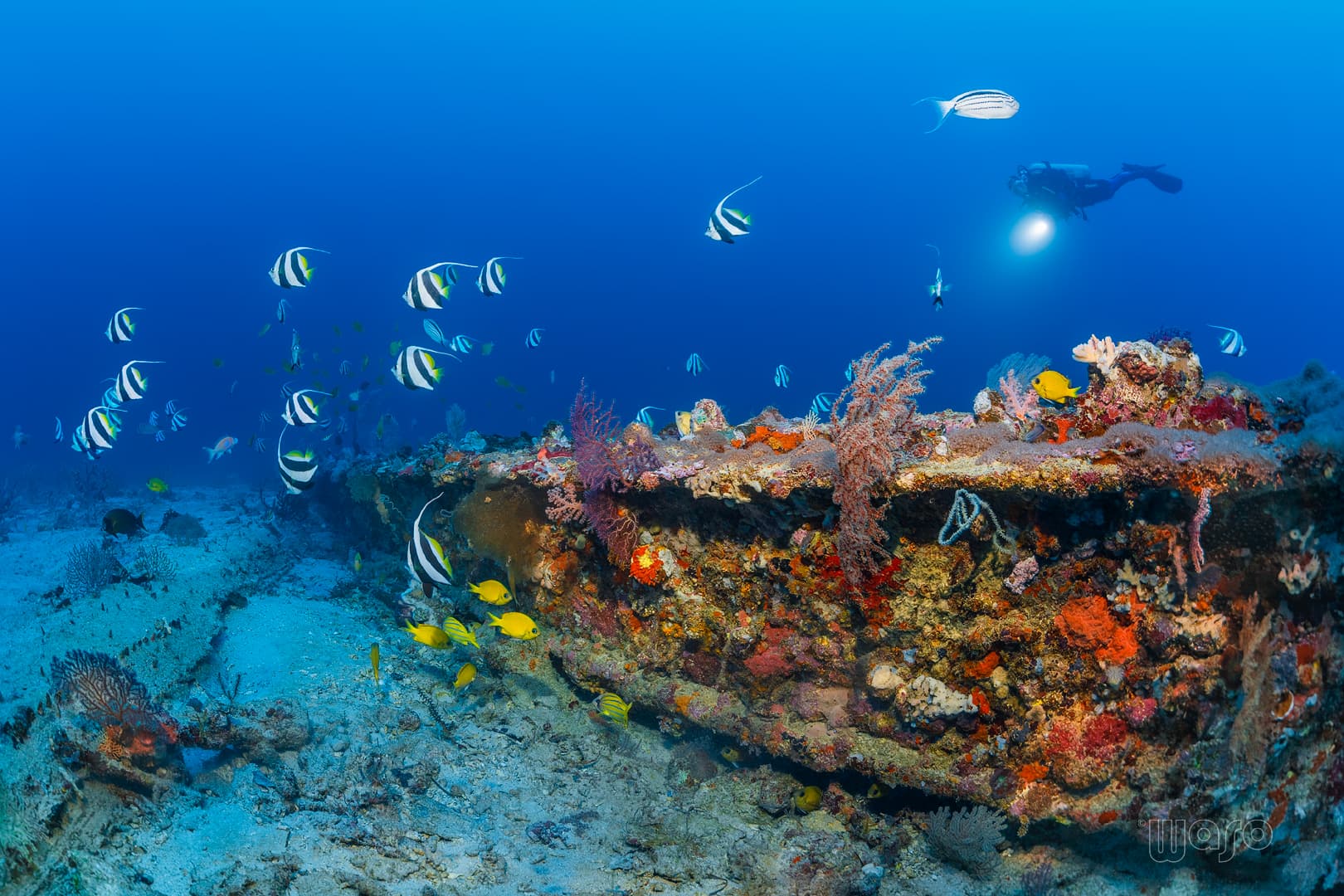
Anchor Wreck is a 19th-century wooden ship resting on the wall’s edge at Menjangan Island. The anchor sits in shallow water at five metres — the namesake feature, often the first thing you see on descent — and the bow drops dramatically to 40 metres. The wood is heavily encrusted in soft coral and decades of marine growth, giving the wreck a kind of organic, half-reef quality. It’s an advanced dive because of the depth and the need for buoyancy control along the wall, but for divers comfortable below 30 metres it’s one of the most atmospheric sites Menjangan offers.
The wreck has been on the wall long enough to develop its own ecosystem. Schooling batfish hover around the bow, scorpionfish camouflage on the timbers, and the inside of broken hull sections shelters lionfish and morays. Reef sharks pass through Anchor Wreck more often than at most Menjangan sites — the dropping wall attracts them. Common sightings include:
Advanced Open Water divers and above, especially those working through the SSI Deep Diving specialty or just looking for a deeper Menjangan dive with a story. The wreck’s shallow anchor makes a useful safety stop reference at 5 metres, and the dive plan is flexible — you can spend most of your time in the 18–30m range and still see the bow dropping into the deep without bottoming-out on no-deco limits. Wide-angle photographers in particular do well here, with the encrusted timbers giving texture-rich foregrounds against blue water.
Best in the dry season (April–November) when visibility peaks and surface conditions are calmest. The site sits inside West Bali National Park, so a park entrance fee applies (already included in our Menjangan day-trip prices). Sundays and public holidays carry a small park surcharge. Because of the depth profile, Anchor Wreck is usually our first dive of the Menjangan day — you get the deepest dive in early when nitrogen loading is lowest, then a shallower second dive at Eel Garden or Coral Garden afterwards. Our 1:4 guide-to-diver ratio applies here too, with extra attention to depth and time signals.